Infrastructure & Industrial Research
Why These Images? The photographs in this Research Archive reveal a consistent investigative pattern spanning four decades: an attraction to infrastructure undergoing transformation, working-class communities navigating systemic change, and material traces that encode invisible processes.
From 1980s documentation of East London industrial wasteland (Stratford’s “Cockney Hideout” café) through 2014 Cold War architecture at Orford Ness, to 2024 Welsh coastal defenses, these images document the same inquiry: How do systems—economic, political, spatial—encode themselves into material reality?
Unconscious Investigation For forty-five years, I photographed transformation zones without consciously articulating why they compelled me. I was drawn to Victorian railway infrastructure, Thames docklands transitioning to luxury, and Welsh valleys bearing material traces of coal. My eye recognized patterns my conscious mind couldn’t yet name.
Visual Intelligence as Research Most institutional art practice follows a “theory-first” methodology. My investigation operated inversely. For decades, I accumulated evidence of sustained inquiry. Only later did I recognize that philosophers like Heidegger and Foucault were describing what I had been investigating visually for forty years. This archive is that evidence—not illustrative of theory, but the investigation itself.
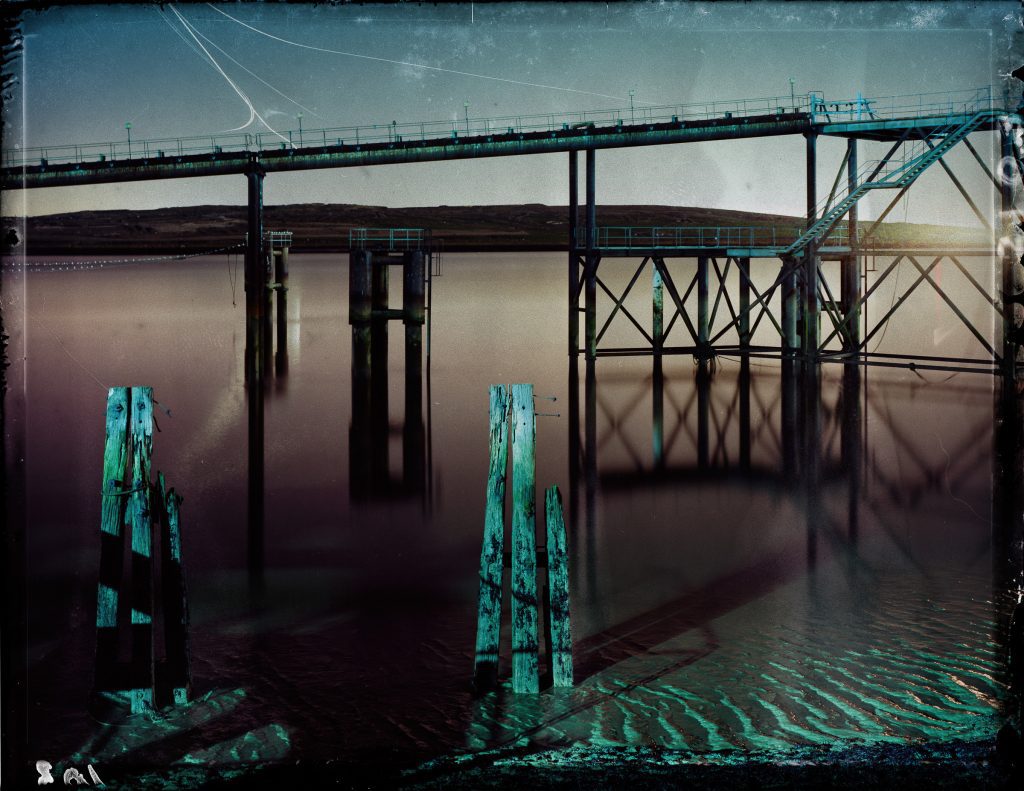
ADM Erith Process Jetty, Thames Estuary
Medium Format Digital, Long Exposure.
Active industrial jetty, ADM Erith rapeseed processing plant, Thames Estuary. The long exposure compresses tidal flow into a mirror-smooth surface while Victorian wooden pilings (foreground) contrast with the functioning modern steel jetty extending into deeper water.
Industrial Continuity (1908–Present): Unlike the “deindustrialization” narrative common to Welsh valleys, this site documents industrial persistence. Established as Erith Oil Works in 1908 to process colonial commodities (copra, palm), the facility has operated continuously for 115+ years. Today, owned by ADM, it processes rapeseed oil using modern pipeline systems visible on the steel jetty, connecting global commodity trade directly to the shore-based factory.
Temporal Layering: The image captures multiple industrial eras simultaneously:
- Victorian (Foreground): Rotting wooden pilings from 19th-century wharves document the era of manual labor and general cargo.
- Modern (Background): The active steel jetty with automated pipelines represents contemporary global agribusiness (24/7 operations, reduced workforce).
Historical Significance: The site’s deep-water access made it a critical strategic location during WWII, where it served as a testing ground for Operation PLUTO (Pipe Line Under The Ocean)—the secret fuel pipelines that supported the D-Day landings.
Why This Matters to Quantum Memory: This site offers a critical counterpoint to your Welsh industrial investigations. While Welsh coalfields saw total collapse and abandonment, the Thames estuary demonstrates adaptation: the same location and river access evolved from colonial trade to modern agribusiness. It questions why some industrial landscapes adapt while others are allowed to fail.
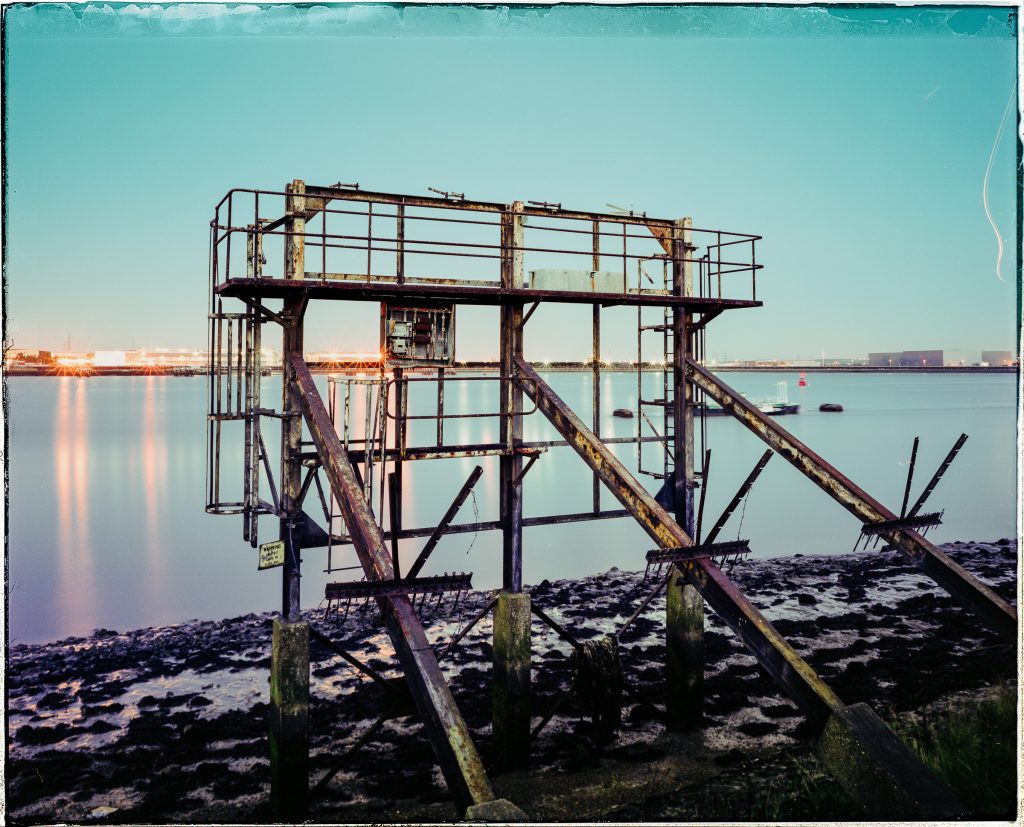
Derelict Coal Conveyor Gantry, Thames Foreshore
Medium Format Digital, Long Exposure.
Surviving section of coal conveyor gantry, Thames foreshore at Thamesmead West, Woolwich. This rusted steel framework supported conveyor belts that transported coal from river barges to Woolwich Power Station (operational until late 1970s demolition) or the Royal Arsenal’s industrial complex.
Industrial Archaeology: The structure embodies temporal layering: 20th-century coal-powered industry now abandoned, mid-20th century power station demolished, yet this skeleton persists in the tidal zone. The aggressive anti-climb spikes (chevaux-de-frise) on angled support beams prevented unauthorized access during tidal cycles. This demonstrates how security infrastructure often outlasts its justification—the spikes continue “protecting” nothing long after the facility closed.
Why This Matters to Quantum Memory: The gantry represents the mid-point in the coal transfer system (River → Conveyor → Bunker). Just as the power station was demolished when the national shift from coal to gas/nuclear occurred , this remaining skeleton documents the physical scale of the energy infrastructure required to power 20th-century London, now reduced to industrial archaeology..

M.F.V. Altmark Wreck, Kenfig Sands
Medium format film, 2024.
The skeletal remains of the M.F.V. Altmark, a wooden fishing trawler that ran aground on Kenfig Sands on June 12, 1960. Abandoned due to the economic unviability of salvaging a wooden hull, the vessel has been stripped by the violent tides of the Bristol Channel for over 60 years, leaving only this “rib-cage” structure rising from the sands.
The “Graveyard of Ships”: This coastline (Sker Point to Margam) is historically defined by maritime peril and working-class survival. In the 18th and 19th centuries, local communities—living in extreme poverty—practiced “wrecking” and looting stranded vessels like the Caterina (1781) for survival resources. Timber from wrecks was frequently repurposed to build the roofs of local cottages, literally weaving maritime disaster into domestic shelter.
Industrial Juxtaposition: The wreck sits in the shadow of the Margam/Port Talbot Steelworks, creating a powerful material contrast: the rotting wooden carcass of the pre-industrial maritime economy versus the blast furnaces of the modern industrial era. Both industries defined the region’s labor; both were dangerous, essential, and dirty. The families walking this beach today are often descendants of the steelworkers and miners who fueled the region, using this shoreline as an escape from the furnace smog.
Why This Matters to Quantum Memory: The Altmark serves as a study in material impermanence and the economic logic of abandonment. Just as the wooden hull was abandoned when it lost economic value, the project investigates how industrial infrastructures (steel, coal) are similarly abandoned when economic logic shifts, leaving behind “carcasses” that persist as monuments to displaced labor.
Technical Details:
- Subject: M.F.V. Altmark (1960 wreck)
- Location: Kenfig Sands, near Margam Steelworks
- Context: “Graveyard of Ships,” S.S. Amazon site
- Themes: Material decay, working-class survival, industrial juxtaposition
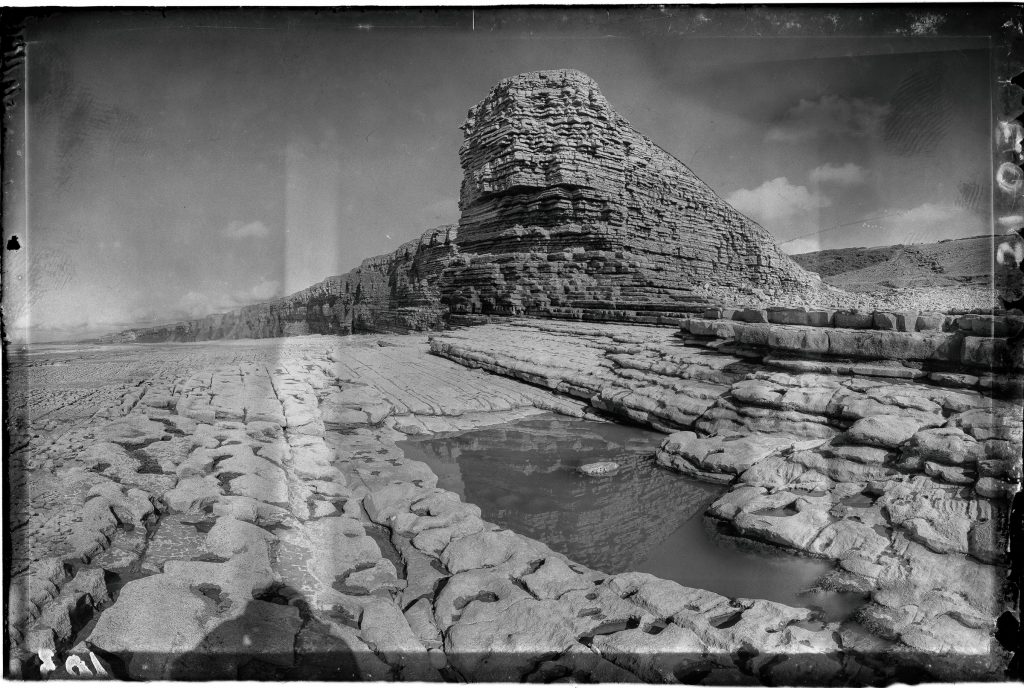
Geological Time & Material Persistence: Nash Point
Medium Format Film, 2024.
200-million-year-old Jurassic limestone formations at Nash Point, Vale of Glamorgan. These horizontal rock strata—laid down layer by layer over millions of years when this land was shallow tropical sea—compress deep geological time into visible pattern. What we see as “solid rock” is actually frozen time—200 million years of accumulated moments compressed into stone you can walk across.
Why This Matters to Quantum Memory: The project investigates how Welsh industrial transformation (coal → slate → steel → silicon) compresses 250 years of economic/social change into material traces. Nash Point demonstrates this principle at a vastly longer scale—showing how time always compresses into material form, whether the material is limestone strata or industrial ruins.
Technical Details:
- Location: Nash Point, Vale of Glamorgan * Geology: Blue Lias limestone, Jurassic Period * Concept: Temporal compression and material persistence
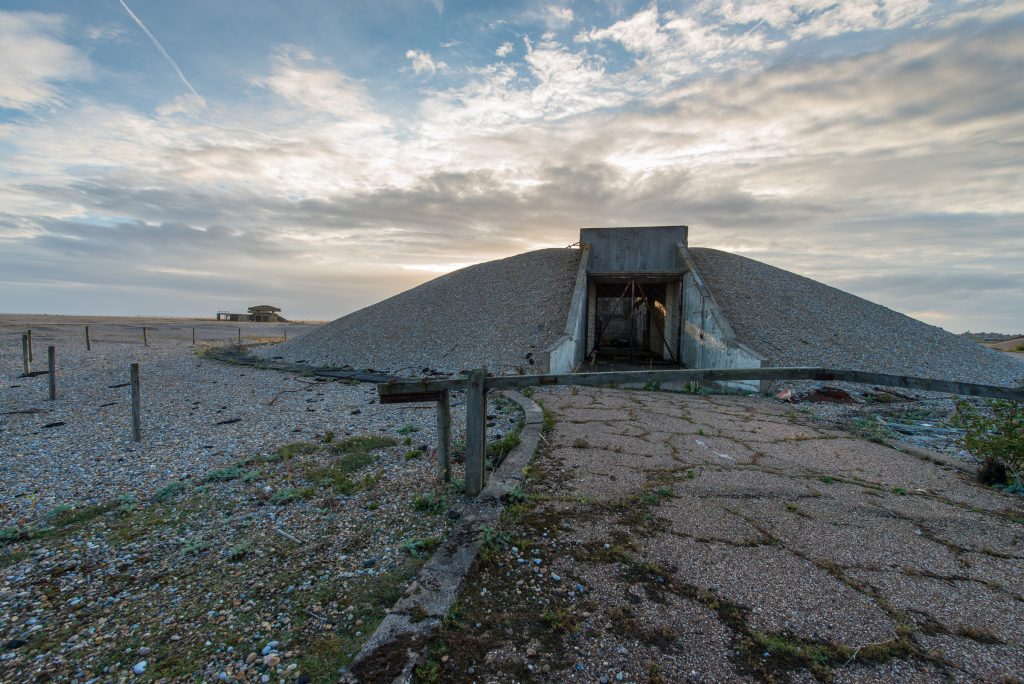
Cold War Infrastructure: Nuclear Testing Pagoda
Nuclear weapons testing structure (“pagoda”), Orford Ness, Suffolk. This earth-covered reinforced concrete bunker was designed to contain nuclear weapon detonations during testing operations, channeling blast force upward while protecting surrounding facilities.
Encoded Anxiety: The name is darkly ironic—Buddhist pagodas symbolize peace, while these military pagodas embodied nuclear violence and state secrecy. The design encodes Cold War paranoia into architectural form: massive capital investment for a structure designed to withstand apocalyptic force.
Why This Matters to Quantum Memory: The structure embodies “architectural encryption”—concrete walls encrypt nuclear testing from observation, just as the Quantum Memory installation encrypts community portraits. It also represents temporal compression: 40 years of Cold War anxiety compressed into a single abandoned material trace.
Technical Details: * Location: Orford Ness, Suffolk (former classified military site) * Structure: Earth-covered reinforced concrete vibration testing bunker * Context: Architecture of the surveillance state
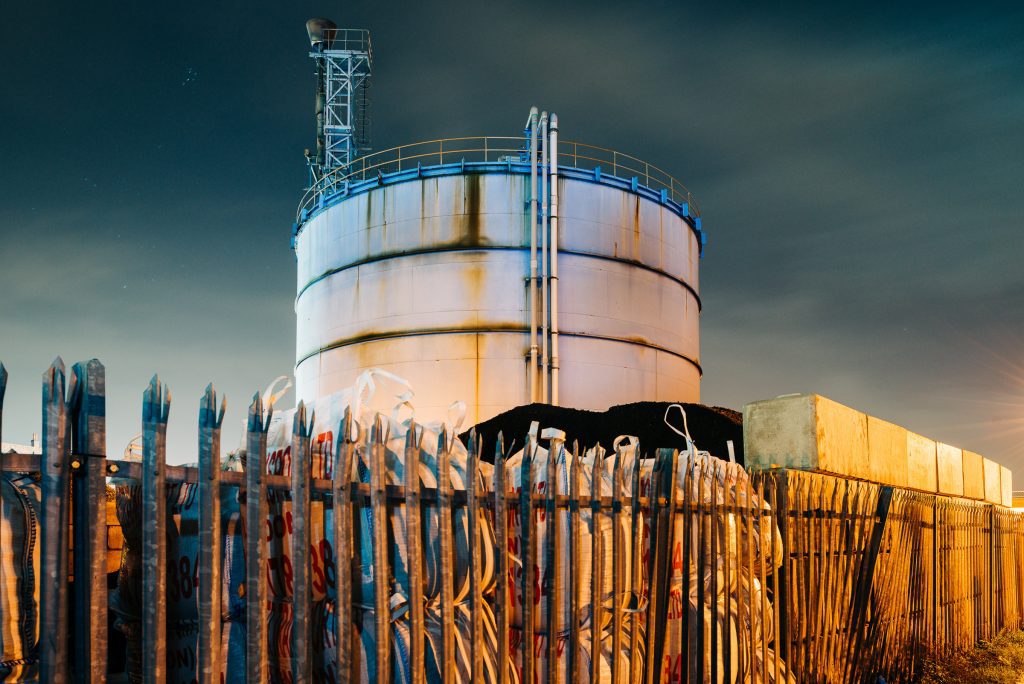
Blackwall Tunnel / Glucose Works
Digital Photograph.
Liquid storage tank at the former Tunnel Refineries (Amylum UK/Tate & Lyle) plant on the Greenwich Peninsula. The facility processed maize and wheat into glucose syrups and industrial starches, dominating the riverside with its infrastructure and distinctive sweet smell until its closure in 2008.
Accelerated Erasure: Unlike Victorian infrastructure that often stands derelict for decades, this modern facility was completely demolished within 2-4 years of closure (2010-2012). The site is now brownfield land designated for the Morden Wharf luxury residential development. The image documents a vanished landscape—capturing working industry (visible bulk bags in foreground) shortly before its total erasure.
Why This Matters to Quantum Memory: This represents “accelerated obsolescence.” While Welsh coal infrastructure lingered for decades as ruins, contemporary industrial sites are erased almost instantly to make way for real estate capital. The photograph serves as one of the few remaining archival proofs of this working-class industrial history.
Technical Details:
- Location: Tunnel Avenue, Greenwich Peninsula
- Subject: Glucose Works storage tank
- Status: Demolished (2010-2012)
- Theme: Rapid deindustrialization and gentrification
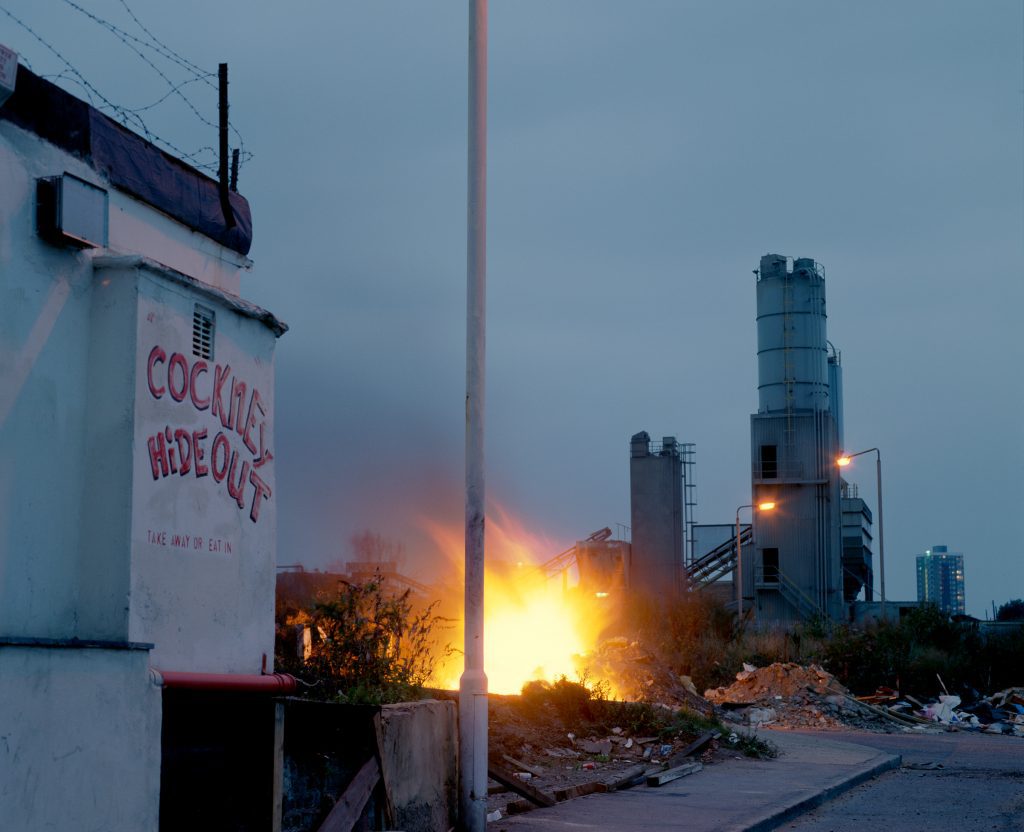
Cockney Hideout, Stratford (1980s)
Analogue Film.
Derelict cafe and industrial site near Warton Road, Stratford, East London. The hand-painted sign marks working-class identity on an abandoned building, while industrial flames illuminate the background silos at dusk.
Total Erasure: This wasteland site—secured with barbed wire and functioning as an informal dumping ground—now lies beneath the London 2012 Olympic Park. The entire physical landscape has been erased and rebuilt. The image documents the “before” state of a total transformation: Stratford’s industrial economy in terminal decline, creating dangerous liminal zones where formal control had collapsed but new development hadn’t yet arrived.
Why This Matters to Quantum Memory: This image serves as material proof of a 40-year investigation. It demonstrates that the documentation of transformation zones, working-class displacement, and liminal spaces has been central to this practice for decades—long before the current Welsh industrial investigation began.
Technical Details:
- Date: 1980s
- Location: Warton Road, Stratford (Now Olympic Park)
- Context: Pre-regeneration East London
- Status: Completely erased/redeveloped